
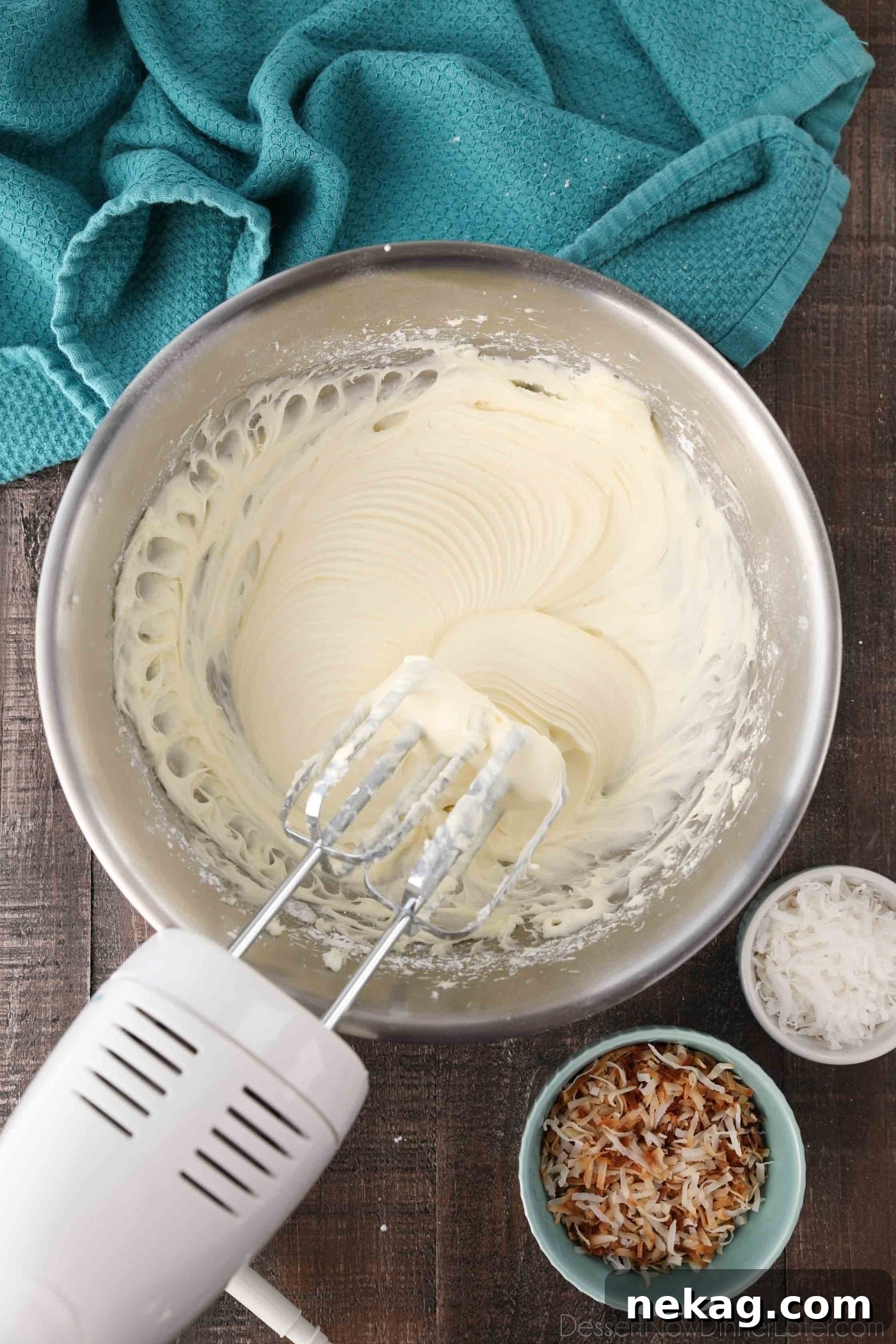
Welcome to the ultimate guide for crafting the most delightful **Coconut Cream Cheese Frosting** you’ll ever taste! This recipe stands out by expertly swapping traditional vanilla with pure coconut extract, delivering an incredibly smooth and vibrant flavor profile. Designed to be wonderfully thick and perfectly pipeable, it uses significantly less powdered sugar than most recipes – just 1 ½ cups – ensuring a frosting that’s rich and creamy without being overly sweet. For those who love an added textural dimension, incorporating shredded coconut flakes is an easy and highly recommended option. Get ready to transform your desserts with this truly irresistible topping!
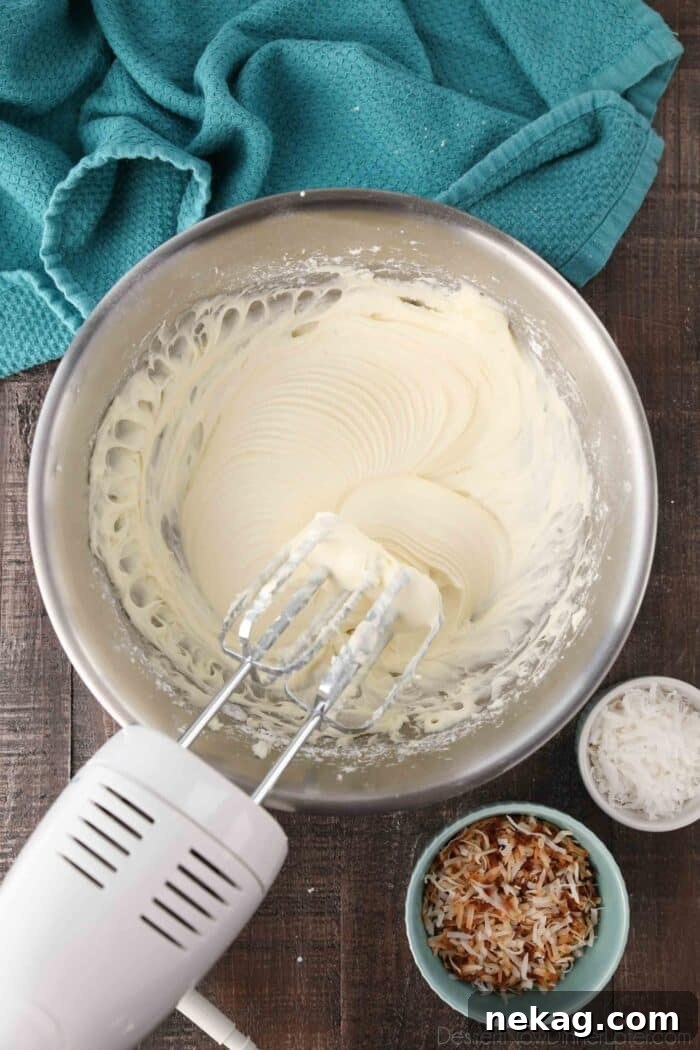
The Delight of Less-Sweet Frostings: Why Cream Cheese Reigns Supreme
For many dessert enthusiasts, cream cheese frosting holds a special place, and for excellent reasons. My personal preference for cream cheese frosting stems from its distinct, irresistible tang. This subtle tartness beautifully balances the sweetness, creating a more sophisticated and enjoyable flavor experience than many other frostings. What truly sets cream cheese frosting apart, especially when compared to a classic American buttercream, is its remarkable ability to achieve a rich, luxurious consistency with significantly less powdered sugar – often up to 75% less! This means you can indulge without the cloying sweetness that sometimes accompanies heavily sugared frostings, allowing the true flavors of your cake or cupcake to shine through.
Beyond its incredible flavor balance, cream cheese frosting is also incredibly versatile. It serves as a fantastic base for an array of delightful flavor variations. Over the years, I’ve enjoyed experimenting with numerous renditions, each bringing its own unique charm to baked goods. Here are just a few of my personal favorites, demonstrating the adaptability of this beloved frosting:
- Classic Cream Cheese Frosting
- Decadent Chocolate Cream Cheese Frosting
- Bright Lemon Cream Cheese Frosting
- Fruity Strawberry Cream Cheese Frosting
- Light & Airy Whipped Cream Cheese Frosting
Each variation builds upon the creamy, tangy foundation, proving that cream cheese frosting is not just a topping, but a canvas for culinary creativity. And today, we’re diving into another star creation: a smooth, luscious coconut version that promises to transport your taste buds to a tropical paradise.
The Secret to Perfect Coconut Cream Cheese Frosting: Extract vs. Milk
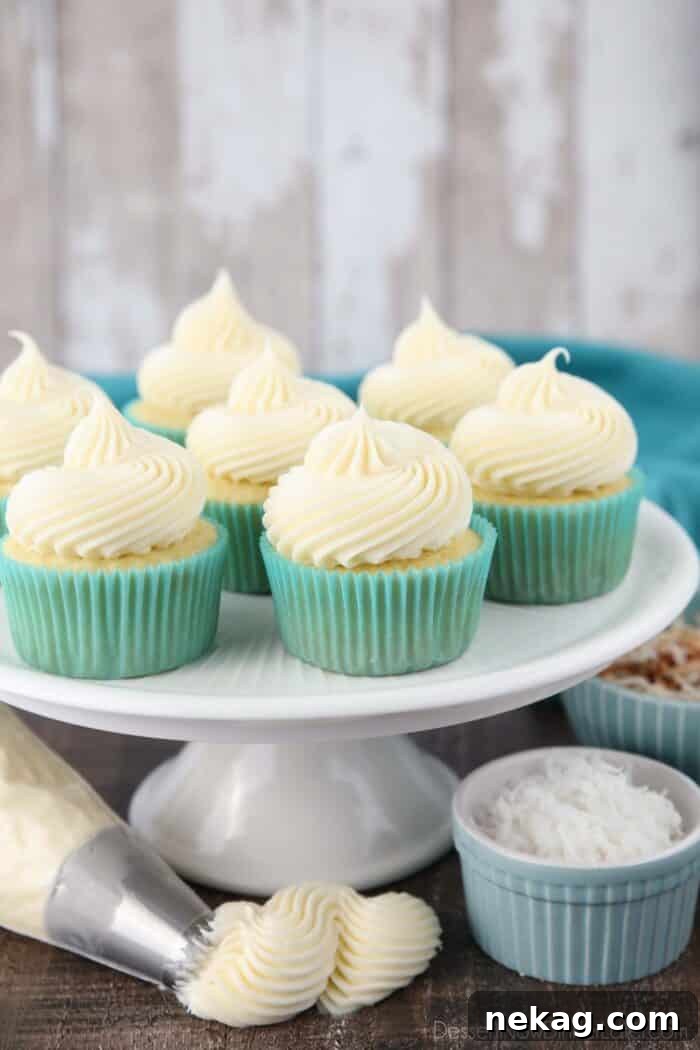
Creating a truly exceptional coconut cream cheese frosting requires careful consideration of how to infuse that tropical flavor without compromising the ideal texture. For this specific recipe, my primary goal was to achieve a frosting that is wonderfully **smooth**, stable, and perfectly **pipeable**. This meant ruling out certain common coconut ingredients that, while delicious, would alter the consistency too much.
For instance, attempting to flavor cream cheese frosting with liquid ingredients like coconut milk or coconut cream often leads to challenges. Cream cheese frosting, by nature, is sensitive to added liquids; too much can make it undesirably soft, runny, or even stringy. The delicate balance of fats and sugars needed for a thick, sturdy frosting would be disrupted, rendering it unsuitable for piping intricate designs or holding its shape on cupcakes and cakes, especially in warmer environments.
This is precisely why I opted for **coconut extract** as the star flavoring agent in this recipe. By using a concentrated extract, we achieve a vibrant burst of authentic coconut flavor with only a minimal amount of liquid. This ingenious substitution allows us to maintain the crucial characteristics of a superior frosting: keeping it beautifully **thick**, wonderfully **sturdy**, and effortlessly **pipeable**. The result is a frosting that not only tastes incredible but also looks professionally crafted, making it ideal for all your celebratory baking.
Elevating Texture: Can You Add Shredded Coconut Flakes?
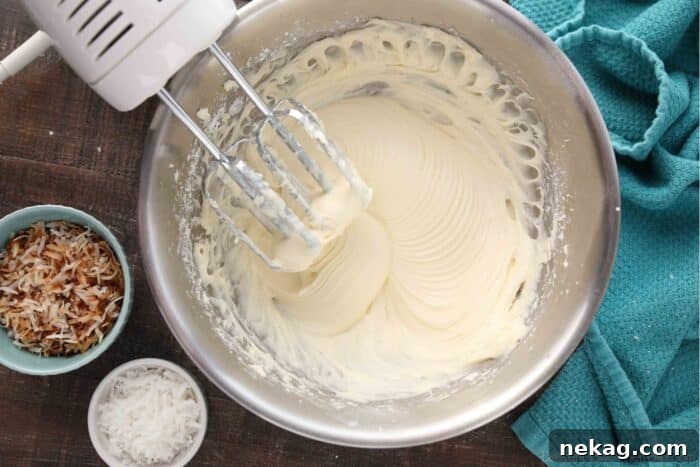
While the smooth, creamy texture of this coconut cream cheese frosting is undeniably delightful, some bakers and dessert lovers crave an extra layer of texture. If you enjoy the delightful chew and distinct presence of **shredded coconut flakes** or **desiccated coconut** in your frosting, you are absolutely encouraged to incorporate them into this recipe! It’s a fantastic way to enhance both the flavor and mouthfeel, adding a rustic yet refined touch.
For those eager to add this textural element, you can confidently **add about 1/2 cup** of shredded coconut to the frosting. Whether you choose sweetened or unsweetened coconut is entirely up to your preference and desired level of sweetness. Sweetened flakes will lend a bit more sugar and a softer chew, while unsweetened will offer a purer coconut flavor and a slightly firmer bite.
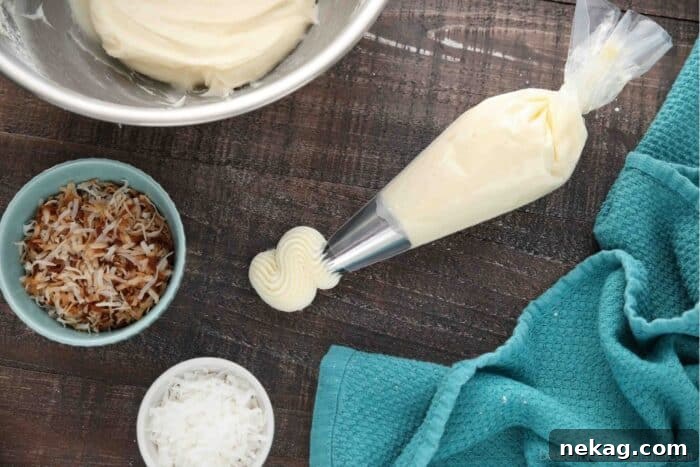
A quick tip for optimal incorporation: if your coconut is in large, coarse shreds, I highly recommend giving it a **quick, rough chop** before adding it to the frosting. This minor step helps distribute the coconut more evenly and prevents large pieces from clogging your piping bag or creating an uneven spread. While you’ll still be able to spread the frosting onto a cake or cupcakes with the coconut bits inside, it’s important to note that the presence of these flakes will affect its pipeability. If you plan on piping, especially with smaller or more intricate tips, the coconut bits might obstruct the opening. However, if you’re set on piping, a large open star piping tip, such as the Ateco 869, can work wonderfully, allowing the larger flakes to pass through relatively easily, creating beautiful, textured swirls.
The Essential Ingredients for Irresistible Coconut Cream Cheese Frosting
Crafting this smooth, pipeable coconut cream cheese frosting requires just four key ingredients. Each plays a crucial role in achieving the perfect flavor and texture, so understanding their specific characteristics and preparation is vital for success.
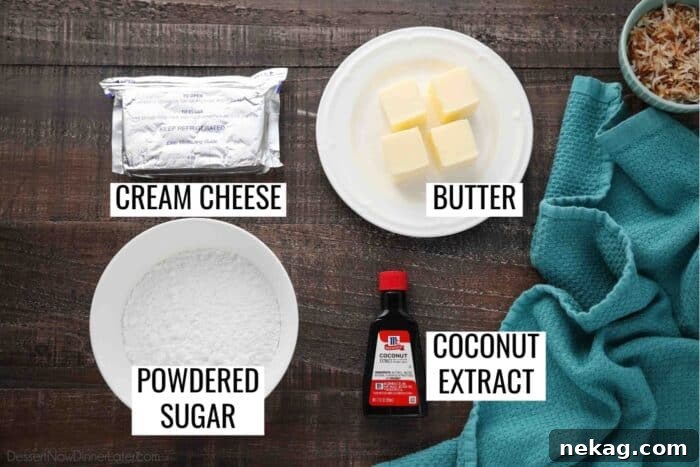
- Cream Cheese: COLD. This is perhaps the most crucial instruction for cream cheese frosting. Using cold cream cheese helps to achieve a thick, stable, and truly pipeable texture. If your cream cheese is at room temperature, the frosting will likely turn out too soft and runny. You can use either full-fat cream cheese for a richer flavor and firmer set, or Neufchatel cream cheese for a slightly lighter option without significantly compromising texture. Ensure it’s a block of cream cheese, not the spreadable kind from a tub, as the latter has too much water content.
- Unsalted Butter: ROOM TEMPERATURE. In contrast to the cream cheese, your butter absolutely needs to be at room temperature. Softened butter creamed with the cold cream cheese creates a magical emulsion, gradually warming and smoothing the cream cheese while keeping the overall mixture cool enough to maintain its structure. Using unsalted butter gives you control over the salt content; if using salted butter, you might want to slightly reduce any additional salt in your cake recipe.
- Powdered Sugar (Confectioners’ Sugar): This recipe shines with only **1 ½ cups of powdered sugar**, which is considerably less than many other frosting recipes. This reduced amount contributes to the frosting’s balanced sweetness and highlights the tang of the cream cheese and the distinct coconut flavor. Powdered sugar, also known as confectioners’ sugar, contains a small amount of cornstarch, which helps stabilize the frosting and prevents it from clumping. Sifting your powdered sugar before adding it can help prevent lumps, though vigorous beating usually smooths them out.
- Coconut Extract: The star of our show for flavoring! Coconut extract delivers a concentrated, authentic coconut taste without introducing excess liquid. This is essential for maintaining the frosting’s thick and pipeable consistency. A good quality extract will provide a pure, tropical essence, making your frosting truly stand out.
By preparing these four ingredients as instructed, you’re well on your way to creating a flawless and delicious batch of coconut cream cheese frosting.
Step-by-Step: How to Make Coconut Cream Cheese Frosting
Making this delectable coconut cream cheese frosting is straightforward, requiring just a few simple steps and a bit of attention to detail to ensure a perfect, pipeable consistency. Follow these instructions carefully, and you’ll have a batch of dreamy frosting ready in no time.
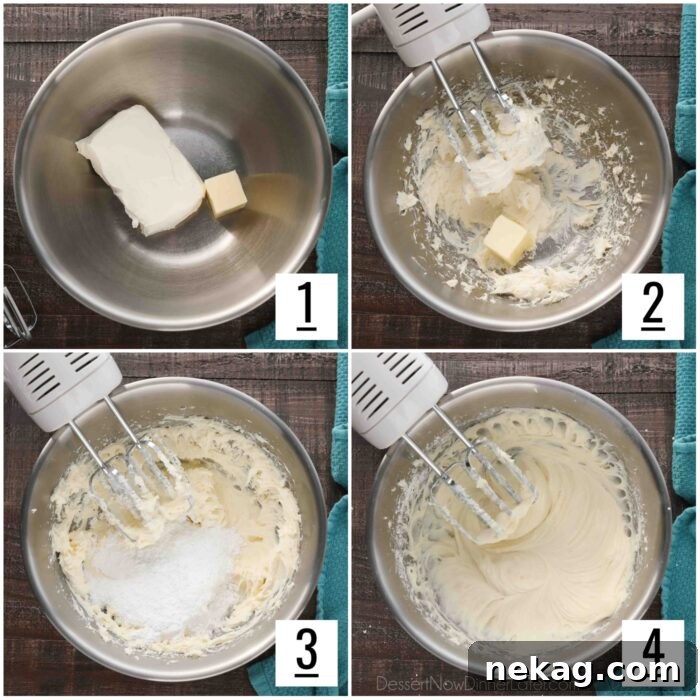
- Begin by placing the **cold cream cheese** (straight from the refrigerator!) and **2 tablespoons of room temperature butter** into a large mixing bowl. The contrast in temperatures is key for the initial creaming process.
- Using an electric hand mixer (or a stand mixer fitted with the paddle attachment), start beating the cream cheese and butter on low speed, gradually increasing to medium. Continue to beat until the mixture is beautifully smooth and well combined. Now, gradually add the remaining butter, about 2 tablespoons at a time, continuing to beat after each addition until thoroughly blended and smooth. This gradual addition helps maintain the frosting’s stability and prevents it from becoming too soft too quickly. Be patient, those initial lumps will disappear as the butter incorporates.
- Once your cream cheese and butter mixture is perfectly smooth and creamy, add the **powdered sugar** and **coconut extract** all at once to the bowl.
- With the mixer on low speed to prevent a cloud of powdered sugar, begin blending until the sugar is fully incorporated and the frosting appears completely smooth. **Be very careful not to over-mix at this stage!** As soon as the powdered sugar disappears and the frosting is uniform, stop mixing. Over-mixing after adding the sugar can incorporate too much air or warm the frosting excessively, leading to a runny, stringy, or gooey texture.
Your luscious coconut cream cheese frosting is now ready! For the best results and easiest application, use the frosting immediately to spread generously or pipe artfully onto your favorite cakes or cupcakes.
Pro Tips for a Flawless Coconut Cream Cheese Frosting
Achieving a consistently perfect batch of coconut cream cheese frosting is entirely within reach with a few expert tips. These insights will help you avoid common pitfalls and ensure your frosting is always thick, creamy, and delightful.
1. Master Ingredient Temperatures: The Cold Cream Cheese, Room Temperature Butter Rule.
This is the golden rule for cream cheese frosting, and it cannot be stressed enough: always use **COLD cream cheese** and **ROOM TEMPERATURE butter**. I frequently get asked if I truly mean *cold* cream cheese, and my answer is an emphatic YES! The firmness of the cold cream cheese helps create a stable base, while the softened room temperature butter gradually incorporates, helping to smooth out the cream cheese without making the mixture too warm or soft too quickly. Don’t fret if you see small lumps initially; with consistent beating, they will beautifully disappear. For precision, I find that a hand mixer offers better control for cream cheese frostings, allowing you to target areas that need extra mixing more accurately than a stand mixer might.
2. The Art of Mixing: Do Not Over-Mix!
One of the most critical tricks to achieving a thick, sturdy, and pipeable cream cheese frosting is to avoid over-mixing, especially once the powdered sugar is added. You can beat the cream cheese and butter mixture quite a bit until it’s perfectly smooth. However, once you introduce the powdered sugar and coconut extract, you want to mix just until the powdered sugar is fully incorporated and the frosting is smooth and uniform. Mixing for too long after this point can lead to several undesirable outcomes: the frosting can become stringy, gooey, and sticky due to the starch content in the powdered sugar, or it can become overly soft and lose its structure, making it impossible to pipe. Additionally, prolonged mixing can generate friction, causing the frosting to warm up and become too soft.
3. The Quick Fix: When in Doubt, Refrigerate.
Even seasoned bakers can sometimes end up with frosting that’s a bit softer than desired. If you’ve diligently followed all the steps and your coconut cream cheese frosting still seems too soft to pipe or spread effectively, don’t panic! The simplest and most effective solution is to refrigerate it. The butter within the frosting will firm up relatively quickly, especially if placed in a cold stainless steel bowl. Pop the bowl into the refrigerator for about 10-20 minutes. Once it has firmed up to your liking, give it a quick stir (by hand or briefly with the mixer on low) to restore its smooth consistency, then fill your piping bag and top your cupcakes or cake with confidence. For very warm kitchens, you might even consider a few minutes in the freezer.
4. Storage and Shelf Life.
Properly stored, this coconut cream cheese frosting will last for several days. Keep it in an airtight container in the refrigerator for up to 3-5 days. Before using it again, allow it to come to room temperature for about 15-30 minutes, then give it a quick whip with your mixer to restore its creamy texture. This frosting also freezes well for up to a month; simply thaw it in the refrigerator overnight and re-whip before use.
5. Serving Suggestions and Flavor Pairings.
This versatile coconut cream cheese frosting is perfect for a wide array of desserts. It’s a natural complement to carrot cake, red velvet cake, or vanilla cupcakes, adding a tropical twist. Consider pairing it with a lemon or lime cake for a bright, refreshing combination. It also works beautifully on brownies, sugar cookies, or even as a filling for whoopie pies. For an extra touch of elegance, sprinkle some toasted coconut flakes on top of your frosted creations just before serving.
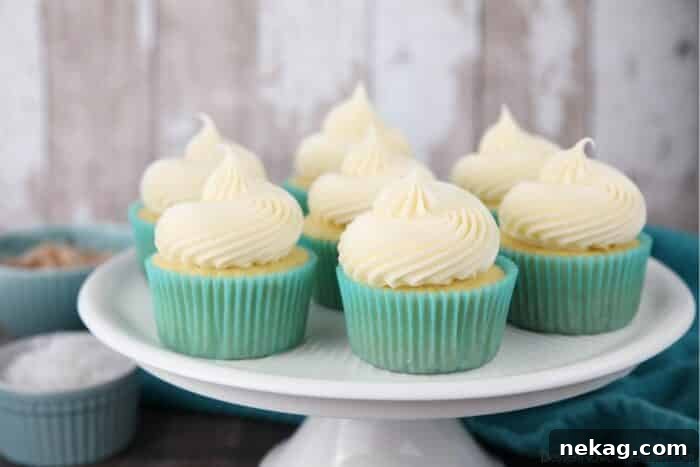
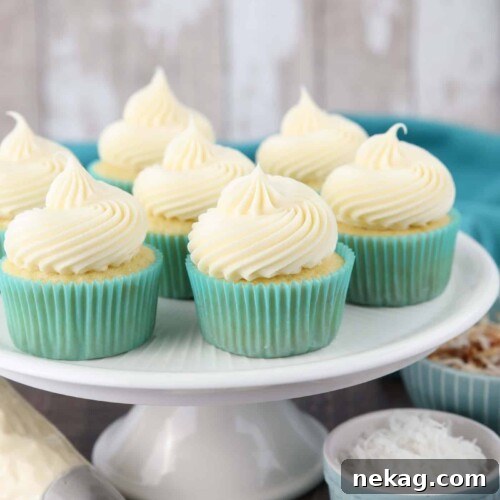
Coconut Cream Cheese Frosting
Created by Amber Brady
Prep time: 5 mins
Total time: 5 mins
Classic cream cheese frosting flavored with coconut extract for a smooth, pipeable frosting.
Yields approximately 2 cups of frosting, enough to frost about 16 cupcakes.
Ingredients
- 8 oz (226 g) brick cream cheese, COLD (Neufchatel can also be used)
- ½ cup (113 g) unsalted butter, (1 stick) room temperature
- 1 ½ cups (180 g) powdered sugar
- 1 ½ tsp coconut extract
Equipment
- Ateco 869 Open Star Tip (optional, for piping)
- Electric Hand Mixer
- Large Mixing Bowl (e.g., 6-Quart Steel Mixing Bowl)
Instructions
- Place the cold cream cheese and 2 tablespoons of room temperature butter in a large bowl.
- Using an electric hand mixer, beat until smooth. Gradually add the remaining butter, 2 tablespoons at a time, continuing to beat until smooth and well-blended after each addition.
- Add the powdered sugar and coconut extract all at once.
- Blend until combined and smooth. Be careful not to beat for too long, as overmixing can make the frosting too soft to pipe. If this happens, place the frosting in the refrigerator or freezer for 10-20 minutes until it firms back up.
Notes
If desired, you can add 1/2 cup of roughly chopped coconut flakes or desiccated coconut (sweetened or unsweetened) to the frosting when mixing in the powdered sugar and coconut extract. This adds a lovely texture. Please note that frosting with coconut bits will be more difficult to pipe through smaller tips. For best results with added coconut, I recommend using a large open star piping tip like an Ateco 869. However, using such a wide tip may mean you’ll only be able to frost about 12 cupcakes with this recipe quantity.
Nutrition
Disclaimer: Nutritional values were calculated using a third-party tool and are provided as an estimation only. Exact values may vary based on ingredients and preparation methods.
- Serving: 1 serving
- Calories: 94 kcal
- Carbohydrates: 11 g
- Protein: 1 g
- Fat: 5 g
- Saturated Fat: 3 g
- Polyunsaturated Fat: 2 g
- Cholesterol: 15 mg
- Sodium: 48 mg
- Sugar: 11 g
Sharing this recipe with a link is both encouraged and appreciated. Copying/pasting and/or screenshots of full recipes to any social media is strictly prohibited. Content and photographs are copyright protected.
Did you make this recipe?
Don’t forget to leave a rating below and make sure to follow on Pinterest and Instagram for more delicious recipes and baking inspiration!