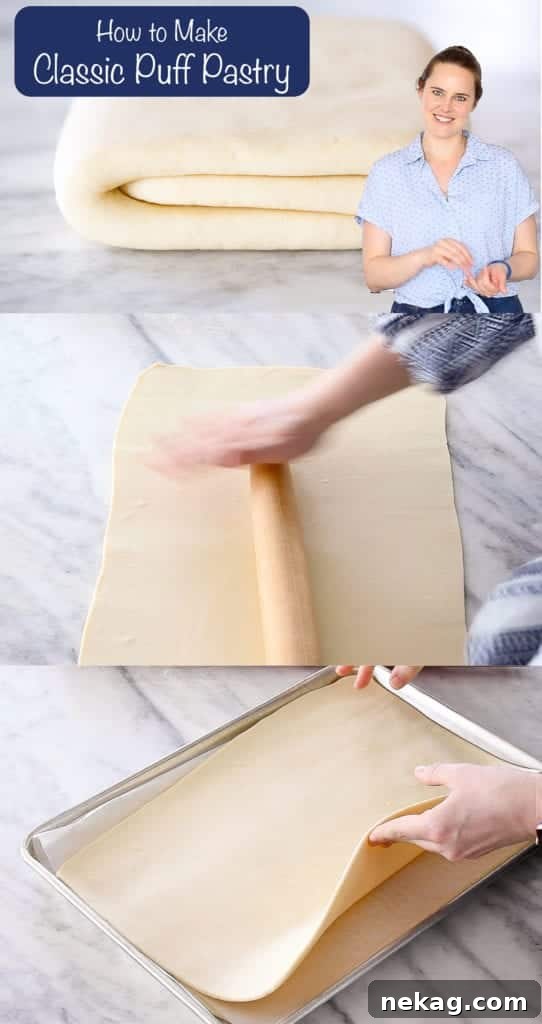
Mastering Classic Puff Pastry: Your Guide to Flaky Perfection
Unlock the secrets to crafting exquisite, buttery, and incredibly flaky classic puff pastry right in your own kitchen. This comprehensive guide, complete with professional insights and an easy-to-follow approach, will empower you to create pastry that far surpasses any store-bought alternative. Prepare to impress yourself and your guests with delicate layers of golden perfection!
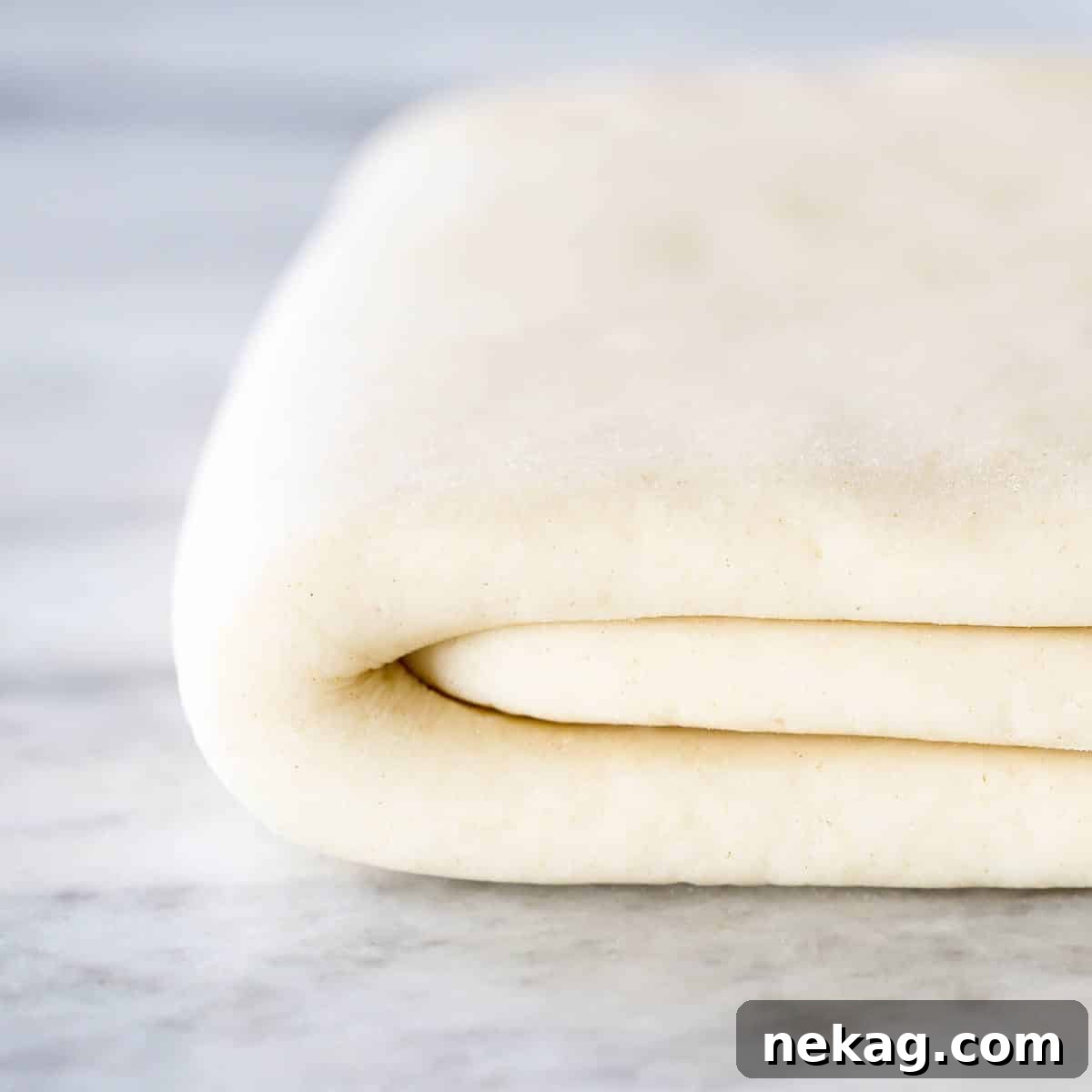
With this classic puff pastry recipe, developed by a professional pastry chef, your dreams of creating light, airy, and rich pastries will truly come to life. The versatility of homemade puff pastry is boundless. Imagine elegant puff pastry fruit tarts bursting with seasonal flavors, delightful cinnamon sugar twists for a sweet treat, delicate palmiers perfect with coffee, or savory applications like this incredible baked pear recipe, and even a show-stopping individual beef wellington.
While I typically dive straight into the technicalities, allow me a moment to share a personal story that underpins my passion for pastry, and indeed, for the very foundations of this craft.
The culinary world, like many others, faced unprecedented challenges. One of the saddest casualties of this period was my beloved culinary school, The International Culinary Center (ICC), which closed its doors. This announcement struck me deeply, arriving at a time when much of my industry, including myself, was experiencing unemployment. It felt as if a significant part of my professional identity had vanished.
ICC was more than just a school; it was a home. It was the reason I moved to New York City six years ago and where I forged friendships that have lasted a lifetime, including meeting my best friend. It was where Robin Hom, a truly exceptional mentor, patiently taught me knife skills on a cutting board in his office, preparing me for a stint as a savory line cook. I was apprehensive, having only focused on pastry, but his willingness to help exemplified the incredible spirit of the people at ICC – they consistently went above and beyond for the love of the industry and their students.
My career flourished significantly because of ICC. It was there that I found and hired many of my most successful cooks and sous-chefs, like Mara and Abigail, who became invaluable colleagues. The institution provided me with the expertise and confidence to become a pastry chef, propelling me to rapid success. The unwavering support from the chefs and staff extended long after graduation, solidifying my connection to this extraordinary place.
A few months ago, driven by a nostalgic impulse, I reached out to the school. To my immense surprise and delight, I was able to purchase their industrial dough sheeter. Though it might not be the newest or shiniest piece of equipment, this machine became the cornerstone of my new pie-selling venture.
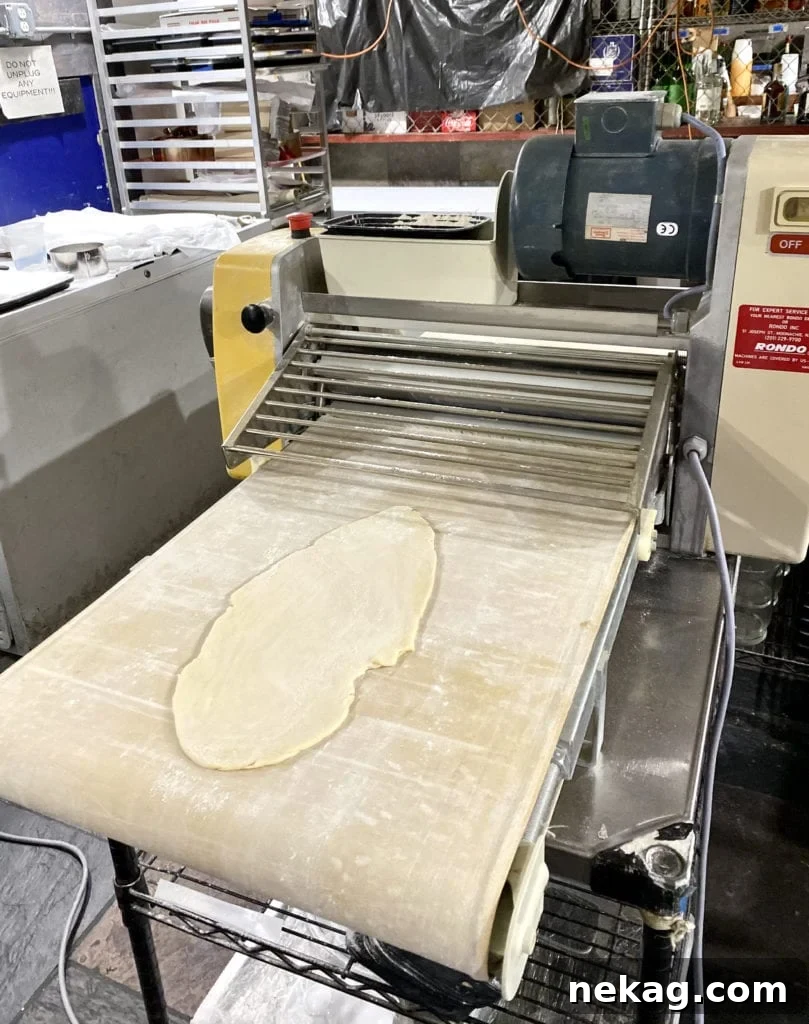
Without that dough sheeter, the task of rolling 500 pie crusts by hand would have been utterly insurmountable. Mara, my talented sous chef and fellow ICC graduate, and I set up the machine in the basement of Restaurant Marc Forgione, where Chef Marc graciously installed a special plug just for us. We spent countless hours learning the machine’s nuances, producing more pie dough than either of us had ever encountered. Every time we walk by it now, we give it a loving pat, a silent tribute to its role in our journey and a fond remembrance of ICC and the wonderful people it brought into my life. That school will forever hold a special place in my heart.
You might wonder how this personal narrative ties into puff pastry. Perhaps it’s a tale of dedication, precision, and the right tools—qualities essential for this delicate dough. Or perhaps, it simply highlights the enduring impact of a truly great culinary education on a professional’s craft and passion, a passion that I pour into every recipe, including this one.
Keys to Classic Puff Pastry Success: The Art of Lamination
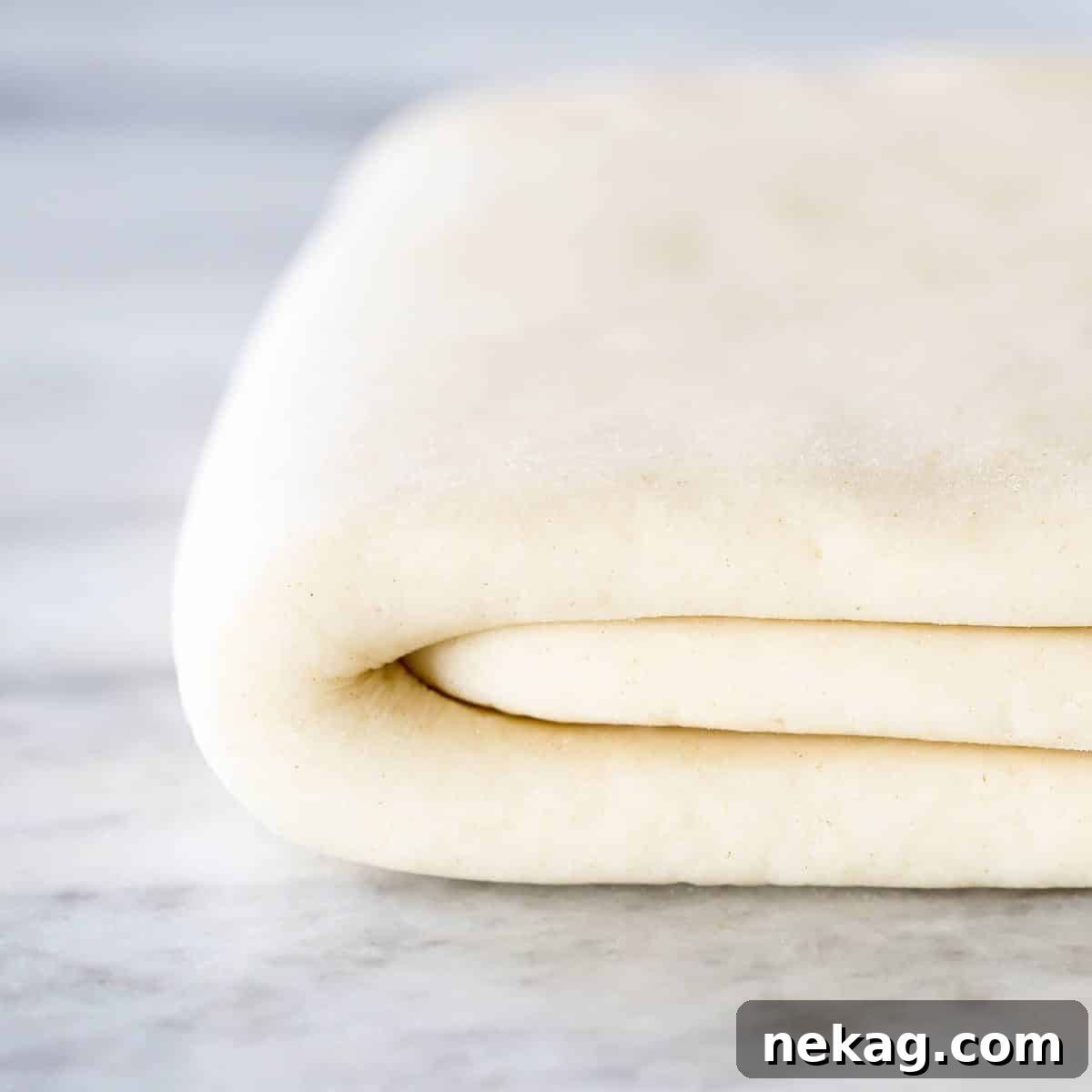
Crafting perfect puff pastry, whether classic or inverse, relies on mastering similar fundamental techniques. The primary distinction in classic puff pastry is the arrangement: the crucial butter packet, known as the beurrage, is enveloped within the dough packet, or détrempe. Following this initial enclosure, the precise cycle of folding, chilling, and rolling begins, ultimately leading to those coveted flaky layers.
The magic behind puff pastry’s incredible texture lies in a process called lamination. This intricate technique involves creating numerous, distinct layers of butter and pastry dough through a series of meticulous folds. When this laminated dough is introduced to a hot oven, the butter within these layers rapidly melts. The water content in the butter instantly evaporates, generating steam. This steam, trapped between the dough layers, dramatically pushes them apart, causing the pastry to puff and expand. The result? A magnificently layered, impossibly buttery, and irresistibly awesome creation.
It’s clear, then, that all that desirable flakiness hinges on two critical factors: the successful creation of these individual layers and their careful maintenance throughout the process. Compromise either, and your pastry risks becoming tough, dense, or unevenly textured.
Understanding the Folds (Turns)
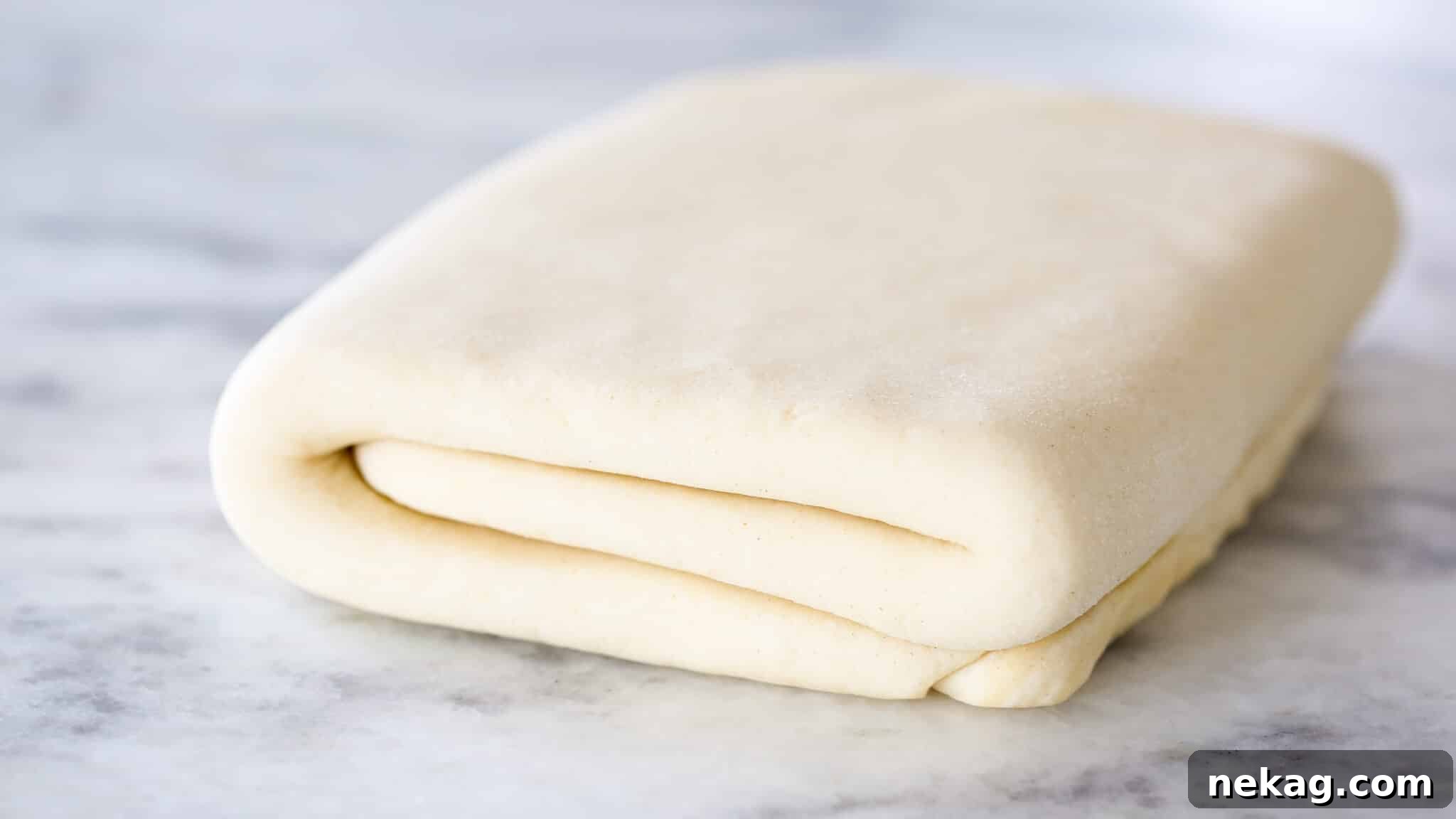
The layers are meticulously built by performing a series of folds, often referred to as “turns.” In the world of pastry, there are two primary folding methods: the single fold (also known as an envelope fold) and the double fold (or book fold). The specific number and combination of these folds directly dictate the final layer count and, consequently, the texture of your puff pastry. Even slight variations in the folding sequence can yield dramatically different results.
For classic puff pastry, my preferred method involves executing six single folds, performed in three sets of two. This particular sequence provides an ideal balance of flakiness and structural integrity.
The Importance of Temperature and Patience
A crucial rule to remember: never attempt more than two turns at a time, especially with classic puff pastry. Pushing the dough too quickly will cause the gluten to contract excessively, making it incredibly difficult, if not impossible, to roll the pastry thin enough. Furthermore, the butter will inevitably warm and soften, leading it to incorporate into the dough rather than maintaining its distinct layers. Preserving the integrity of the butter layers is paramount, as essential in pastry as integrity is in life itself.
Both the successful creation and diligent maintenance of these delicate layers are entirely dependent on keeping the butter consistently cold yet pliable. If the butter is too cold and rigid when rolled, it will fracture into pieces, resulting in uneven and ultimately disappointing layers. Conversely, if the dough is not adequately chilled, it will become overly elastic, unyielding, and difficult to work with, causing the butter to melt and merge prematurely.
Developing Dough Intuition
Perhaps the most vital skill in pastry, particularly with laminated doughs, is learning to truly pay attention to your dough. You must understand its nuances intimately, recognizing its struggles and frustrations, so you can react immediately and provide what it needs. Dough can never be forced; instead, you must learn tricks to control and cooperate with it. If the dough begins to shrink back, it’s a clear signal that it needs to relax – return it to the refrigerator to chill. If the butter feels too hard, practice patience or learn how to gently manipulate it to achieve the desired pliability within your timeline. My video tutorial offers valuable visual guidance on this.
If I could condense all my advice into one essential snippet, it would be this: Do not rush, and always keep your dough cold and flat! Neglecting these principles will compromise the lamination, rendering all your hard work futile. And that, truly, is a sad outcome. At CLF, we avoid sadness; we embrace butter. Loads and loads of butter.
If you tried this recipe and loved it, please leave a 🌟 star rating and let me know how it goes in the comments below. I love hearing from you; your comments make my day!
★
★
★
★
★
5 from 4 ratings
Classic Puff Pastry
Comment
Print Recipe
Ingredients
Détrempe (the dough part):
- 160 g Water cold
- 4 g White Vinegar
- 12 g Salt
- 125 g Beurre en pomade softened butter
- 15 g Sugar
- 198 g Cake Flour
- 198 g AP Flour
Beurrage (the butter part):
- 375 g Butter cold but pliable
Instructions
-
Fold a piece of parchment paper into a 6.5-inch square; this will be your guide for the butter. Set aside.
-
To prepare the Détrempe (dough): In the bowl of a stand mixer fitted with a paddle attachment, combine all dry ingredients. Add the softened butter (beurre en pomade) and mix until no visible butter chunks remain and the mixture is crumbly. In a separate container, combine the cold water and white vinegar. With the mixer on low speed, gradually pour the water/vinegar mixture into the flour mixture. Mix until a cohesive dough forms. Turn the dough out onto a clean, unfloured surface and gently knead for a minute or two until all dry bits are fully incorporated (you can moisten specific dry spots with cold water if needed). Form the dough into a 10-inch square, wrap it tightly in plastic wrap, and chill in the refrigerator for 30 minutes.
-
For the Beurrage (butter block): Just before you plan to combine the butter and dough, gently beat the cold but pliable butter with a rolling pin to soften it slightly and make it more malleable. Place the softened butter inside your pre-folded parchment square and roll it flat, ensuring the butter fills all corners of the 6.5-inch square evenly. Work quickly to keep the butter cold yet pliable.
-
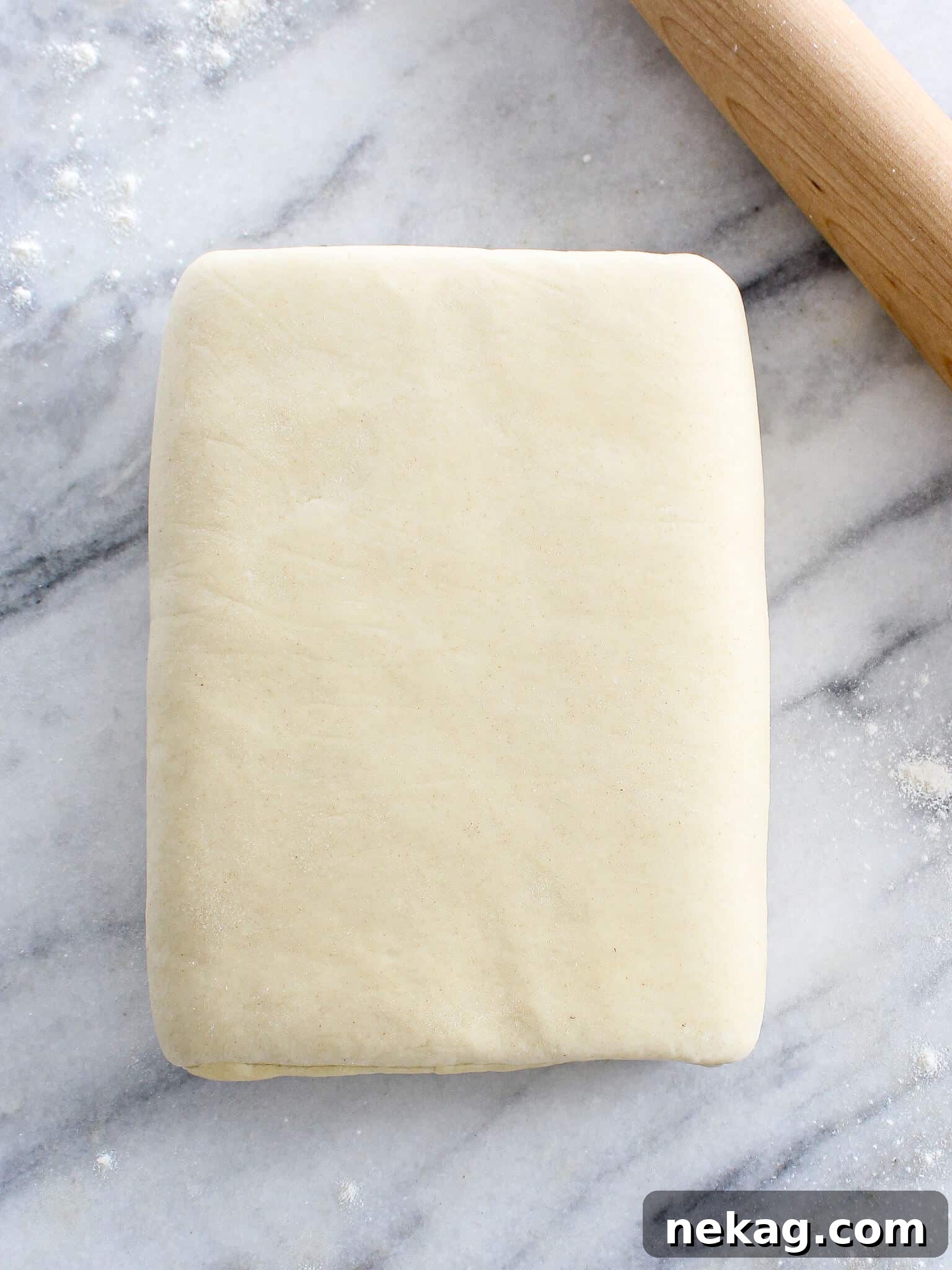
Lamination – First Two Turns: Place the butter block (beurrage) diagonally onto the center of the chilled détrempe. Fold the corners of the détrempe over the beurrage, enclosing it completely, and gently seal the seams with a rolling pin. Lightly flour your work surface and the top of the dough. Roll the dough into an approximate 18 x 7-inch rectangle. Perform an envelope fold (single fold) by folding the top third of the dough down and then overlapping it with the bottom third, just like folding a letter for an envelope. Rotate the dough 90 degrees. Roll it out again to 18 x 7 inches and perform another envelope fold. Wrap the dough tightly in plastic wrap and chill for 30 minutes.
-
Repeat the process of rolling, folding (two single turns), and chilling twice more, ensuring a 30-minute chill time between each set of two turns. This will give you a total of six single turns.
-
After the final set of turns, chill the puff pastry dough for at least 2 hours, or preferably overnight. Overnight chilling allows the gluten to fully relax and the butter to firm up, making it easier to roll and ensuring optimal flakiness.
-
Final Roll-Out: Once thoroughly chilled, roll the puff pastry dough to approximately 1/8 inch (3mm) thick. Chill the dough as needed to prevent it from becoming too warm or shrinking back. A helpful tip is to roll the entire piece of dough to the approximate size of a baking sheet, then chill it. Once chilled, slice the dough in half with a pizza cutter. Work with one half while the other chills, swapping them out as they warm up or begin to shrink, until both halves reach the desired 1/8-inch thickness. You should end up with two pieces of dough, each roughly the size of a standard baking sheet.
-
Preparation for Baking: Before using the dough for your desired recipe, ensure it is thoroughly chilled for at least 30 minutes. Cut the dough into the desired shapes, then use a fork or pastry docker to gently prick the dough (this helps prevent excessive puffing in unwanted areas). Chill the cut and docked dough one last time before baking. It is crucial not to allow the dough to warm up to room temperature before baking, as this will prevent the distinct layers from forming properly and achieving that characteristic puff.
-
Bake in an oven preheated to 375°F (190°C), preferably with a convection setting for optimal crispness.
Video Tutorial
Nutrition
Enjoyed this recipe? Share your thoughts below!
More Culinary Delights
If butter is truly your love language, and you appreciate the elegance of French desserts, then you absolutely must try this exquisite mille crepe cake next. It’s another classic that showcases delicate layers and rich flavor, perfect for expanding your baking repertoire!